

Search Website

Industry Projects
Get Involved with an Industry Project today!
Industry Projects
Get Involved with an Industry Project today!
Industry Projects
Get Involved with an Industry Project today!
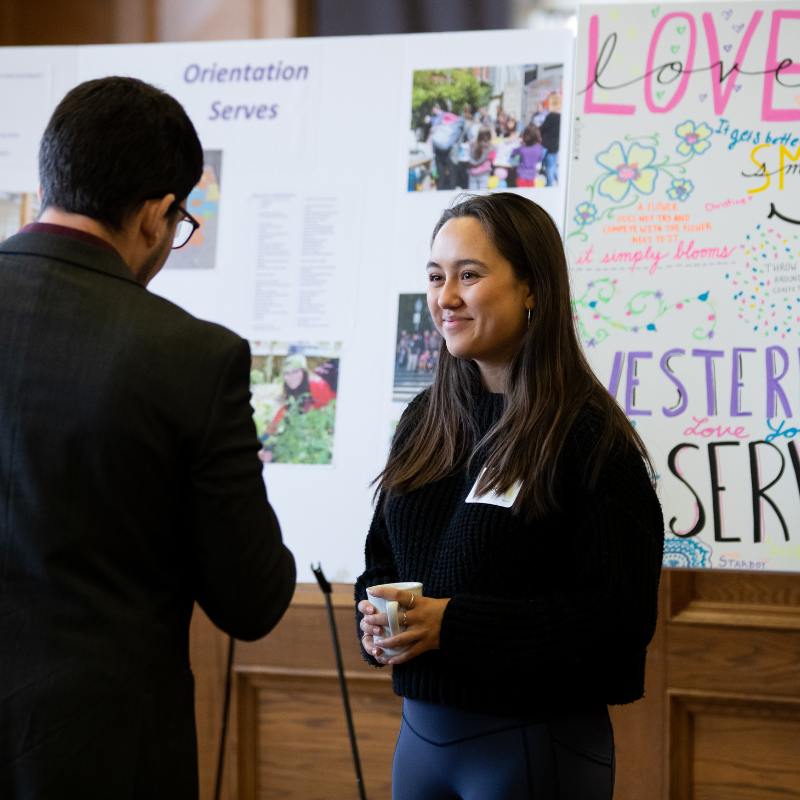
Working under the supervision of industry partners from local, small- to medium-sized businesses, students apply classroom learning to practical scenarios and hone their core competencies for credit in their courses. Industry Projects are defined by partner organizations to meet their unique needs and are intentionally aligned with the learning outcomes of courses in various disciplines at both the undergraduate and graduate level.
Get In Touch
Contact the Industry Project Coordinator at industryprojects@uwo.ca to start a conversation.
Looking to host Western students for an Industry Project? Visit the hirewesternu site.
Explore our 2026-2027 Course Offerings:
Faculty of Arts and Humanities
Kate Stanley
Winter 2027
This course introduces essential skills and methods in literary studies, focusing on the process of scholarly research. We will consider how the research skills we are developing in grad school can be put to work in a variety of contexts, both within and beyond the university. Students will be guided step-by-step through the formulation of a focused and persuasive research project proposal, from conducting scholarly searches; to constructing generative research questions; to compiling relevant literature reviews; to articulating a project’s structure, methodology, and original contribution. This process will scaffold research projects for our graduate program (eg. course essays, independent research projects, grant or fellowship applications, dissertations, conference papers, scholarly articles etc.) as well as for various non-academic or alt-academic areas of work (eg. for arts/non-profit grant proposals; government and NGO projects; private sector research and development etc.). The course will also feature guest speakers and workshops that support students in articulating the relevance of their graduate skills and humanities expertise for a range of career pathways. Students will complete the class with a literature review, research proposal, CV and resumé.
Faculty of Engineering
Michael Boutilier
Winter 2027
The purpose of this course is to introduce chemical engineering students to the basics of momentum transfer and fluid flow in part through the application to real-world engineering problems. Topics include: conservation of mass, momentum and energy, flow of fluids, measurement of fluid flow, laminar and turbulent flow, compressible and incompressible flow, pumps, nozzles, flow meters, and turbines.
Previous Project: Aided Carriff Canada with their product marketing by using laboratory resources to provide accurate flow rate data.
HaoTian Harvey Shi
Fall 2026
This course introduces students to the modern industrial processes common in the manufacturing of various engineering products. The relationships between materials properties, manufacturing processes, and the performances of the finished components are studied. The course combines theoretical principles with practical applications to equip students with the skills necessary for addressing contemporary challenges in manufacturing industries.
Previous Project: Evaluated current designs and recommended changes to materials selection for one of Maglin Site Furniture’s products to reduce associated environmental impacts.
John Makaran
Full Year 2026-27
This full-year capstone course is the culmination of everything MME students have learned in their program. Students develop and practice engineering design skills by working on a team-based project. Students experience all phases of the design process, including problem definition, generation and evaluation of concepts, engineering analysis, prototyping, testing, and preparation of design documentation. Students are evaluated on their technical deliverables, but also on their project management, time-management, and communication skills.
Faculty of Science
Daniel Jeffery
Fall 2026 & Winter 2027
This course uses project-based inquiry to give senior genetics students hands-on experience with molecular biology techniques allowing them to refine their laboratory skills, practice analyzing and reporting results to academic and lay audiences, and cross-referencing outcomes to the scientific literature. Experimental approaches include bisulfite sequencing, quantitative reverse-transcription PCR, and CRISPR-mediated gene knockout.
Ashley McAlpine
Fall 2026
In this course, students develop the important business skills that are often not emphasized in the formal education of quantitative financial professionals. The course focusses on how businesses work, financial statement analysis, oral and written communication, and leadership/people management.
Previous Projects:
- Developed frameworks for a new work order, customer, & product tracking application for Hetek Solutions Inc. using software available in-house.
- Researched new markets for GreenTech Painting and recommended strategies for franchise expansion using risk assessment, financial modelling, and more.
Ashley McAlpine
Fall 2026
In this course, students develop the important business skills that are often not emphasized in the formal education of quantitative financial professionals. The course focusses on how businesses work, financial statement analysis, oral and written communication, and leadership/people management.
Previous Project: Researched potential new markets for the deployment of proprietary technology developed by Konnexio Inc. including a comprehensive overview of associated benefits and risks.
Faculty of Social Science
Lindsay Bell
Winter 2027
This course serves as an introduction to how anthropologists study everyday life to reveal the meanings and consequences of what often seem like mundane, routine actions. Shopping is a ubiquitous activity that we may take for granted as "normal". Indeed, our daily lives involve the purchase and consumption of "lots of stuff." More than simply being about individual materialism, this course explores how shopping is a cultural practice. We will learn how to closely observe shopping environments to discover what people’s procurement practices reveal about their social relationships and identities. We will explore the diversity of ways in which people shop as well as what they shop for. We will think about local and global consumer culture with an eye towards a better understanding of both human creativity and social inequality.
Wes Kinghorn
Fall 2026
This course is an examination of geographical theories of local and international trade. Topics include the relationships between the location of production and flows of goods, services and factors of production among countries and regions, and the geographical patterns of world commerce.
Wes Kinghorn
Fall 2026 and Winter 2027
This course is an examination of tourism as a global, national, and local phenomenon, with economic, social, and environmental impacts. The emphasis of this course is on tourism as placemaking. Topics include tourism theory, major tourist destinations, climate change impacts, media influences, hosts, guests, local tourism, and tourism of imaginary places.
Previous Projects:
- Researched organizations located along the Thames Valley Parkway for London Bicycle Café to identify potential opportunities for growing the city’s active transportation community.
- Researched restaurants, grocery stores, and food manufacturers located in London for Ukrainian Pierogies Inc. to identify potential collaborators in the establishment of a multicultural tourism route.
Jacqueline Book
Winter 2027
This course will focus on current issues in the aviation industry. It will better prepare students for aviation leadership and management. It is intended to broaden thinking on current topics such as environmental, EDI, industry projections, and issues facing todays airlines, airports, workforce and businesses.
Bonnie Simpson
Fall 2026
This course introduces principles of sustainability in the global marketplace. The focus is on an international experiential approach to building knowledge and critical thinking skills to evaluate the role of marketing in creating, facilitating, and communicating sustainable marketing activities, including barriers for sustainable consumption practices and tools to overcome them.
King's University College
Joseph Turnbull
Winter 2027
In this course, students learn various approaches for solving complex problems and then apply them to a group-based analytics project executed in collaboration with a not-for-profit, educational, private, or government partner. Students connect approaches to research in cognitive science, behavioural economics, numerical methods, and aligned fields to develop problem-solving processes that are effective for ill-defined problems, as well as problems for which there is no established framework or template.